


.png)


.svg)


%20(1).jpg)
Champions League Knockout Stage 2026: What Every Fan Needs to Know
Twenty-four teams have booked their tickets to the Champions League knockout stage for 2025/26, and the elimination rounds promise to deliver some of the most exciting football we've seen in years. After nearly five months of action, 144 matches, and a staggering 487 goals scored during the league phase, Europe's premier club competition is ready to crown its next champion.
The new format brings fresh excitement right from the start. Eight teams earned the privilege of skipping the playoff round entirely, advancing straight to the round of 16 based on their league phase performances. Arsenal, Barcelona, Bayern München, Chelsea, Liverpool, Manchester City, Sporting CP, and Tottenham all secured these coveted spots by finishing in the top eight. The remaining sixteen teams, those ranked ninth through 24th, will battle it out in knockout phase playoffs, with eight winners earning their place as unseeded participants in the next round.
Perhaps most surprising of all, Paris Saint-Germain finds themselves in the playoff round for the second consecutive season. These two-legged encounters kick off with first matches on February 17-18, followed by the decisive return legs on February 24-25.
We'll walk you through everything you need to know about this revamped format, break down the upcoming fixtures, and explore what makes this year's path to the final so unique.
How teams qualified for the knockout stage
The qualification process for the 2025-26 Champions League knockout stage operated on a straightforward principle: performance in the league phase determined everything. This season's single league table format created three distinct tiers of teams, each with different paths forward.
Top 8 teams that advanced directly
Eight clubs earned the ultimate prize, direct passage to the round of 16 without facing elimination matches. Arsenal led the charge with a flawless 8-0-0 record, posting an impressive +19 goal difference while accumulating 24 points. Bayern Munich claimed second place with 21 points and a solid +14 goal differential.
The remaining spots went to Liverpool (18 points), Tottenham Hotspur (17 points), and a tight cluster at 16 points featuring Barcelona, Chelsea, Sporting CP, and Manchester City. These weren't just qualification spots, they came with substantial tournament advantages.
Top-eight finishers receive seeded status for the round of 16 draw, guaranteeing them matchups against playoff survivors rather than fellow elite clubs. The benefits extend deeper into the tournament structure. Teams finishing first through fourth will host second legs in potential quarterfinal ties, while the top two finishers maintain this home advantage through the semifinals.
Teams entering the playoff round
Sixteen teams, those finishing ninth through 24th, face a more challenging path through two-legged playoff matches. This group contains several European powerhouses who fell just short of automatic qualification.
The playoff round operates on its own seeding system. Teams ranked ninth through 16th earned seeded status, meaning they'll host the crucial second legs at home. Real Madrid (15 points), Inter Milan (15 points), Paris Saint-Germain (14 points), and Newcastle United (14 points) headline this seeded group.
PSG's placement among the playoff teams represents one of the phase's biggest surprises. The defending champions find themselves in this elimination round for the second straight season, highlighting how competitive the new format has become.
Clubs positioned 17th through 24th enter as unseeded teams, facing an uphill battle to reach the round of 16. Borussia Dortmund, Olympiacos, Club Brugge, Galatasaray, AS Monaco, Qarabag, Bodo/Glimt, and Benfica fill these positions. The presence of Qarabag and Bodo/Glimt proves the format's ability to reward consistent performance from smaller leagues.
Opta's analysis suggests approximately 10 points, roughly three wins and one draw across eight matches, typically secured a top-24 position.
Who got eliminated and why
Twelve teams finishing 25th through 36th saw their European campaigns end completely. Unlike previous seasons, no safety net exists, these clubs don't transfer to the Europa League, representing a significant shift in continental competition structure.
Some eliminations shocked the football world. Ajax, former European champions, finished 32nd with just 6 points and a -13 goal difference. Serie A title-holders Napoli fared only slightly better, placing 30th with 8 points and a -6 goal differential.
The final day produced genuine drama around the 24th and final playoff position. Benfica claimed it with 9 points and a -2 goal difference, edging out Marseille who finished with identical points but a -3 goal difference. One goal in differential made the difference between European survival and elimination.
Pafos, Union Saint-Gilloise, PSV Eindhoven, Athletic Bilbao, Copenhagen, Eintracht Frankfurt, Slavia Prague, Villarreal, and Kairat Almaty joined the elimination list. Villarreal's campaign proved particularly disappointing, they managed just one point from eight matches, tying with Kairat for the competition's worst record.
Understanding the Champions League bracket
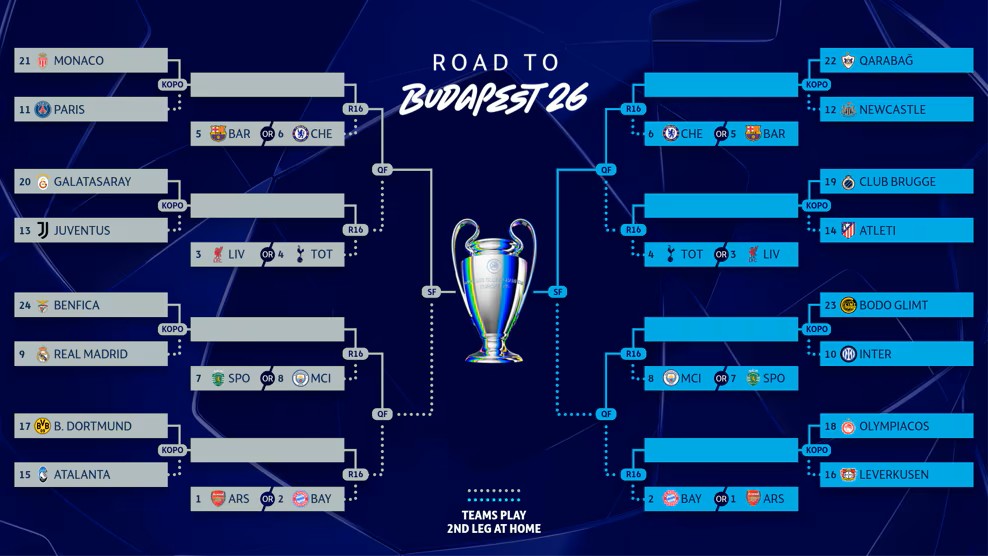
UEFA's revamped bracket system for 2025/26 creates a fascinating tournament structure that's both predictable and unpredictable at the same time. Think of it as a roadmap where you can see every possible destination, but the journey itself remains full of surprises.
What the 2026 Bracket Means for the Top Teams
With the full bracket now visually confirmed, the road to Budapest is no longer theoretical, it is clearly mapped.
Arsenal and Bayern Munich are positioned on opposite sides of the bracket, meaning they can only meet in a potential final. That separation protects the two strongest league-phase performers from colliding too early.
Liverpool and Tottenham also sit in different quarters, reducing the chances of an immediate Premier League showdown between them. However, English clubs could still clash later, as country protection no longer applies.
Chelsea’s side of the bracket could become particularly challenging depending on how the playoff ties resolve. If Paris Saint-Germain or Monaco advance, that section immediately gains a heavyweight dynamic. Meanwhile, Manchester City may be staring at a possible high-stakes clash should Real Madrid progress.
Because the bracket is fixed from this stage onward, teams already know their potential quarterfinal and semifinal paths. That clarity changes strategy. Managers can plan squad rotation, assess fixture congestion, and even mentally prepare for possible rematches.
In this format, positioning is everything. The bracket is locked, now execution decides who survives.
Knockout playoff round: fixtures and format
February delivers the knockout playoff round, where sixteen teams will fight for eight spots in the round of 16. The January 30 draw in Nyon has set up some mouth-watering encounters that will determine which clubs join the elite eight automatic qualifiers.
List of all 8 matchups
The playoff draw has produced fascinating battles between European heavyweights and ambitious underdogs. Based on league phase seeding, here are the eight ties that will shape the round of 16:
- Monaco vs Paris Saint-Germain - French rivals clash with Monaco hosting first
- Galatasaray vs Juventus - Turkish passion meets Italian experience
- Benfica vs Real Madrid - The Eagles welcome 14-time champions to Lisbon
- Borussia Dortmund vs Atalanta - 2023 finalists face Serie A's comeback kings
- Qarabağ vs Newcastle United - Azerbaijani champions host Premier League newcomers
- Club Brugge vs Atlético Madrid - Belgian precision against Simeone's defensive mastery
- Bodø/Glimt vs Inter Milan - Norwegian champions take on Italian title holders
- Olympiacos vs Bayer Leverkusen - Greek giants face Bundesliga's invincibles
Teams ranked 9th-16th earned seeded status, meaning they'll play the crucial second leg at home. The higher-ranked side gets listed first in each pairing, giving you a clear picture of who earned home advantage for the decisive return fixture.
Home and away leg rules
These knockout ties follow a completely different rhythm than the league phase matches. Each encounter spans two legs, with aggregate score determining who advances. Teams play once at home and once away, creating tactical battles that often shift dramatically between venues.
If the aggregate remains level after 180 minutes, we get 30 minutes of extra time. UEFA scrapped the away goals rule, so there's no longer any advantage for scoring on the road. Still deadlocked? Penalty shootout settles the matter.
The seeded teams get a massive advantage here. Playing that second leg at home, with your crowd behind you in potentially the most pressure-filled moments of the tie, can make all the difference. Just ask any team that's won a knockout tie in front of their home support during extra time or penalties.
Dates for first and second legs
The playoff action unfolds over two intense weeks in February, with matches spread across four evenings:
First Legs (February 17-18)
- February 17: Galatasaray vs Juventus (18:45 CET)
- February 17: Monaco vs Paris Saint-Germain (21:00 CET)
- February 17: Borussia Dortmund vs Atalanta (21:00 CET)
- February 17: Benfica vs Real Madrid (21:00 CET)
- February 18: Qarabağ vs Newcastle United (18:45 CET)
- February 18: Club Brugge vs Atlético Madrid (21:00 CET)
- February 18: Bodø/Glimt vs Inter Milan (21:00 CET)
- February 18: Olympiacos vs Bayer Leverkusen (21:00 CET)
Second Legs (February 24-25)
- February 24: Atlético Madrid vs Club Brugge (18:45 CET)
- February 24: Bayer Leverkusen vs Olympiacos (21:00 CET)
- February 24: Inter Milan vs Bodø/Glimt (21:00 CET)
- February 24: Newcastle United vs Qarabağ (21:00 CET)
- February 25: Atalanta vs Borussia Dortmund (18:45 CET)
- February 25: Juventus vs Galatasaray (21:00 CET)
- February 25: Paris Saint-Germain vs Monaco (21:00 CET)
- February 25: Real Madrid vs Benfica (21:00 CET)
The eight winners advance to face the top eight teams from the league phase in the round of 16. That February 27 draw will then establish the complete bracket all the way to Budapest.
For clubs like PSG, appearing in the playoffs for the second year running, these fixtures offer redemption after disappointing league phase campaigns. Every tie carries the weight of a season's ambitions.
Round of 16: what happens next
Once the playoff dust settles, we get to witness one of the most anticipated moments in the Champions League calendar, the round of 16 draw. The eight playoff survivors will join the elite group that earned direct qualification, creating sixteen teams ready to battle for European glory.
How the draw works
The beauty of this new format lies in its structure. Rather than the old system where each round brought a separate draw, everything gets decided in one go on February 27, 2026. This single event maps out the entire journey to Budapest, giving teams and fans a crystal-clear view of the road ahead.
The draw follows a precise pattern based on league phase rankings. The top eight teams automatically become seeded, facing the playoff winners in predetermined matchups:
- Arsenal and Bayern (1st/2nd) will meet winners from the Atalanta/Dortmund vs. Leverkusen/Olympiacos playoffs
- Liverpool and Tottenham (3rd/4th) face winners from Club Brugge/Atletico vs. Galatasaray/Juventus
- Barcelona and Chelsea (5th/6th) play winners from Monaco/PSG vs. Newcastle/Qarabag
- Sporting CP and Man City (7th/8th) get winners from Benfica/Real Madrid vs. Bodo/Glimt/Inter
This structure ensures the highest-performing teams can't clash until the later rounds, creating a true tournament bracket that rewards league phase excellence.
Potential matchups for top 8 teams
The possibilities are already tantalizing. Chelsea could find themselves facing Premier League rivals Newcastle if the Magpies overcome Qarabag. Manchester City might get their hands full with Real Madrid should Los Blancos advance past Benfica.
Arsenal and Bayern, sitting pretty at the top, know they'll avoid the absolute biggest names in the first knockout round. Liverpool and Tottenham could face some familiar opponents, while Barcelona has the intriguing prospect of a potential reunion with PSG.
Perhaps most exciting is the elimination of country protection, English clubs can now face each other at any stage. This means we could see Premier League showdowns as early as the quarterfinals if the cards fall right.
Draw date and seeding rules
Mark your calendars for February 27, 2026, that's when the entire knockout pathway gets locked in. No more waiting for subsequent draws; everything from round of 16 through the final gets determined in one dramatic ceremony.
The seeding benefits extend far beyond this initial round. Teams finishing 1st through 4th maintain their home advantage for potential quarterfinal second legs. The top two finishers keep this privilege all the way to the semifinals. If a seeded team falls, their conqueror inherits these advantages.
First legs kick off March 10-11, 2026, with the return fixtures scheduled for March 17-18, 2026. After years of uncertainty about future opponents, this format brings clarity, teams will know their potential route to Budapest from the moment that February draw concludes.
Key dates for the 2026 knockout stage
Mark your calendars now because the Champions League knockout stage schedule is packed with must-watch football across several months. The revamped format makes it even more crucial to keep track of when your favorite teams are playing, especially with the tournament's path to Budapest taking shape over these key dates.
Playoff round: February 17, 25
February brings the first knockout action, with sixteen teams fighting for their European lives in the playoff round. First legs kick off on February 17-18, 2026, featuring eight matches spread across two action-packed evenings. Teams get about a week to regroup and adjust their tactics before the decisive return legs on February 24-25, 2026.
The scheduling works perfectly for football fans. Early matches start at 18:45 CET, followed by the prime-time 21:00 CET slots on both February 17 and 18. This setup means you can catch multiple games on the same night if you're planning a proper Champions League viewing session.
Round of 16: March 10, 18
Once we know our playoff winners, the real excitement begins. The complete tournament bracket gets finalized during the draw on February 27, 2026 in Nyon, Switzerland. This single draw sets everything in motion, not just the round of 16 matchups, but the entire roadmap to the final.
First legs of the round of 16 take place on March 10-11, 2026, with the return fixtures following exactly one week later on March 17-18, 2026. The same timing pattern continues here, maintaining those 18:45 and 21:00 CET kickoff slots that work so well for European audiences.
Quarterfinals to Final: April to May
Spring brings the business end of the competition. Quarterfinal action unfolds on April 7-8, 2026 for first legs, with return matches on April 14-15, 2026. Remember, there's no separate draw for the quarterfinals, everything gets locked in from that February 27 draw.
The semifinals follow on April 28-29, 2026 and May 5-6, 2026. Teams that finished higher in the league phase keep their seeding advantages throughout, which means home advantage for second legs remains a huge factor.
All roads lead to May 30, 2026, when the Puskás Aréna in Budapest hosts the Champions League final for the first time. Hungary's impressive national stadium provides a spectacular backdrop for crowning Europe's champion, wrapping up what began as a 36-team league phase journey.
Keep in mind these times are all Central European Time, so you'll need to adjust for your local viewing. Final kickoff times for individual matches beyond the playoffs will be confirmed closer to each round.
Country protection and draw rules
The Champions League knockout stage has thrown out the rulebook when it comes to country protection, and this changes everything about how the tournament unfolds. Gone are the days when domestic rivals had to wait until the quarterfinals to potentially clash on Europe's biggest stage.
Can teams from same country face each other?
UEFA has scrapped country protection entirely for the 2025/26 knockout phase. Teams from the same nation can now meet at any stage, right from the playoff round through to the final. This opens up fascinating possibilities we haven't seen before in Champions League history.
Think about the potential drama: Borussia Dortmund could face Bayern Munich in the round of 16 if they both advance. Liverpool might clash with Chelsea or Arsenal much earlier than expected. The Premier League, with four teams in the top eight, could see multiple English showdowns throughout the tournament.
Here's what the rule change means in practice:
• Domestic rivalries can happen at any knockout stage • Multiple teams from one country can appear in the same bracket section
• No waiting until the quarterfinals for those marquee domestic matchups
The change adds unpredictability while potentially reducing some of the international flavor we're used to. But it also means we could witness some incredible domestic battles with European stakes attached.
How UEFA handles repeat matchups
Another significant shift involves repeat matchups between teams. Clubs that already faced each other during the league phase can be drawn together again in the knockout rounds. This represents a major departure from previous formats where such repetitions were typically avoided.
UEFA does maintain some restrictions, though these primarily affect future league phases rather than the current knockout rounds. Teams cannot play the exact same fixture (same home team) for three consecutive seasons in the league phase. So if Real Madrid visited Liverpool in both 2024/25 and 2025/26, that specific fixture couldn't happen again in 2026/27.
But here's the key point: knockout stage matches face no such restrictions. Any team can face any opponent, regardless of when they last met or where they're from.
The result? A completely open knockout format where tactical matchups and previous encounters add extra layers of intrigue to every draw. Teams that struggled against certain opponents in the league phase might get a chance for immediate revenge, or those psychological advantages could carry forward into crucial elimination matches.
Biggest storylines to watch
The knockout stage always delivers drama beyond what any script could imagine. This year's playoff draw has gifted us with storylines that could define entire careers, settle old scores, and create new legends. Let's explore the narratives that will have football fans glued to their screens.
Mourinho's emotional return to Madrid
José Mourinho heads back to the Santiago Bernabéu, but this time he's wearing Benfica colors against his former club. The theater couldn't be more perfect. After Benfica's stunning 4-2 victory over Real Madrid in the league phase finale, Mourinho finally broke his winless streak against Los Blancos. That triumph marked his first-ever victory against the Spanish giants, a monkey off his back that had haunted him for years.
We witnessed pure emotion when Benfica's fourth goal hit the net in the 98th minute. Mourinho celebrated like he'd just won the Champions League itself, though he later confessed feeling conflicted about his wild reaction against his former employer. The relationship between Mourinho and Madrid remains beautifully complex. Spanish journalist Manuel Jabois perfectly captured this dynamic: "if we bring back a bad result from the first leg, the Bernabéu will give Mourinho a standing ovation".
PSG's surprising struggle
Paris Saint-Germain finishing 11th feels almost surreal for a club of their stature. The French champions find themselves in the playoff round for the second consecutive year after their 1-1 draw with Newcastle wasn't enough to secure a top-8 spot.
What makes this even more intriguing is Luis Enrique's unconventional take on their situation. The PSG coach actually believes the additional playoff matches might benefit his team's rhythm rather than hinder it. They'll face Monaco in an all-French affair that promises fireworks between two clubs desperate to prove their European credentials.
Newcastle's European adventure continues
Eddie Howe's Newcastle are living on the edge of elite European football. Last season, they were the great disruptors who announced themselves on the continental stage. This year feels different, they're "clinging to the elite" as they navigate both domestic struggles and European ambitions.
Their reward? A trip to face Qarabag in Azerbaijan. After holding PSG to a 1-1 draw in their final league match, Howe showed his competitive spirit: "We wanted to win tonight. We didn't want the extra games, but we'll take it". When pressed about whether Newcastle belongs at this level, his response was telling: "I think we're showing that".
The Magpies' journey represents something special, a club rediscovering its place among Europe's elite, one match at a time.
What this means for the top 8 teams
Those three weeks of rest while other teams battle for survival can prove decisive come March. Arsenal, Bayern Munich, and the other elite finishers get to fine-tune their tactics, rest key players, and avoid the injury risks that come with high-intensity elimination matches.
More importantly, these teams lock in home advantage for their round of 16 second legs. This means when the pressure peaks and the stakes are highest, they'll have their home crowd behind them during potentially decisive moments like extra time or penalty shootouts.
Who they might face in March
The playoff results will determine exact opponents, but the possibilities are already taking shape:
- Arsenal (1st) & Bayern (2nd): Face winners from Atalanta/Dortmund or Leverkusen/Olympiacos
- Liverpool (3rd) & Tottenham (4th): Meet winners from Juventus/Galatasaray or Atletico/Club Brugge
- Barcelona (5th) & Chelsea (6th): Play winners from Monaco/PSG or Newcastle/Qarabag
- Sporting CP (7th) & Man City (8th): Face winners from Inter/Bodo/Glimt or Real Madrid/Benfica
Chelsea facing Newcastle would create an intriguing Premier League subplot, while Manchester City potentially meeting Real Madrid would deliver an instant classic.
How bracket positioning matters
League phase rankings carry weight throughout the entire tournament structure. Teams finishing first through fourth maintain home advantage for quarterfinal second legs, assuming they haven't been eliminated by lower-ranked opponents who would inherit that privilege.
The bracket ensures Arsenal and Bayern, locked into the top two spots, cannot meet until a potential final. This separation of the tournament's strongest performers creates a natural balance that should produce compelling matchups at every stage.
Remember, these advantages compound over time. Each home second leg becomes more valuable as the tournament progresses and margins get tighter.
Early Favorites and Potential Edges
Looking at the current knockout picture, a few spots immediately stand out. Inter Milano, for example, enter their tie against Bodø/Glimt as clear favorites. On paper, the Italian side has the squad depth, European experience, and defensive structure to control both legs, especially with the second leg advantage in play. In two-legged football, that kind of tactical maturity often makes the difference.
Real Madrid is another side that always commands attention at this stage of the competition. Despite facing Benfica in a competitive matchup, Madrid’s knockout pedigree and experience under pressure historically shift the balance in their favor when the margins get tight.
Of course, Champions League nights rarely follow the script, that’s exactly what makes these markets so compelling. You can explore full match odds, outright winner prices, and qualification markets directly here:
👉 https://flush.com/player/sports/soccer/international/uefa-champions-league-2470546796305330203
All odds are live and may fluctuate as kickoff approaches.
Conclusion
This year's Champions League knockout stage represents a genuine shift in how Europe's premier competition unfolds. Arsenal's flawless league phase performance has earned them the top seed, while European giants like Real Madrid and PSG face the extra challenge of playoff rounds. The new format rewards consistency with real advantages, direct qualification, better seeding, and those crucial home second legs.
February's playoff action promises some unmissable encounters. Mourinho's return to the Bernabéu with Benfica carries serious emotional weight, especially after their stunning 4-2 victory over Madrid in the league phase. Meanwhile, PSG and Monaco will settle their French rivalry before either can dream of advancing further.
The February 27 draw will map out the complete path to Budapest, giving us unprecedented clarity about how the tournament will unfold. No more guessing about potential matchups, teams and fans alike will know exactly what lies ahead.
Perhaps the biggest game-changer is removing country protection rules. English clubs could meet much earlier than before, while German rivals Bayern and Dortmund might clash well before the final. The seeding inheritance system keeps everything fair while rewarding teams that knock out higher-ranked opponents.
You'll want to clear your calendar from February through May as Europe's elite battle for continental glory. The journey ends at Budapest's stunning Puskás Aréna on May 30, 2026, where football history will be made. With this new format creating such clear pathways and exciting possibilities, every match carries extra significance on the road to Hungary.
FAQs
Q1. How does the new Champions League knockout stage format work? The top 8 teams from the league phase advance directly to the round of 16. Teams ranked 9-24 play two-legged knockout playoffs, with the 8 winners joining the round of 16 as unseeded teams. The entire bracket through to the final is then set by a single draw.
Q2. What advantages do the top 8 teams receive in the knockout stages? The top 8 teams skip the playoff round, giving them extra rest. They are seeded for the round of 16 draw and play second legs at home. Teams finishing 1st-4th also get home advantage in potential quarterfinal second legs, while the top 2 have this benefit in the semifinals.
Q3. Can teams from the same country face each other in the knockout stages? Yes, country protection has been eliminated in the new format. Teams from the same nation can now meet at any stage of the knockout rounds, including as early as the round of 16.
Q4. What happens to teams eliminated from the Champions League? Unlike previous years, teams finishing 25th-36th in the league phase are eliminated from European competition entirely. They do not drop into the Europa League as in past seasons.
Q5. When and where is the 2026 Champions League final? The 2025/26 UEFA Champions League final is scheduled for May 30, 2026. It will be held at the Puskás Aréna in Budapest, Hungary, marking the first time this venue hosts the prestigious match.

.png)
.png)




.png)
.png)
.svg)
.png)

.png)


